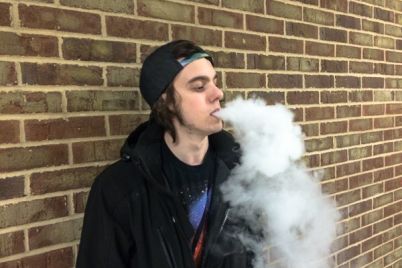
As staff writers here at The Voice, part of our job is to talk with students on campus about what issues they are concerned about here at Washtenaw Community College. And as part of the discussion, two things always come up: Smoking and parking.
Ah, everyone’s two favorite topics. While I’m not here to revisit those issues, it’s interesting to me that the conflicts are always on going at WCC and haven’t been resolved. The disputes have gone back to the beginning of our school’s Huron River campus in the 1970s.
I’ve been going back in time, so to speak, doing some research for other stories here on campus. When I was looking at old copies of The Voice from the ’60s and ’70s, two conflicts stood out: Smoking and parking.
Back then, the smoking issue was based around whether or not students and staff should be allowed to smoke in classrooms and hallways. Smokers were fired up about the idea of being assigned an area where they could smoke indoors. The compromise that non-smokers wanted was for smokers to simply go outside.
More than 40 years later, we are still dealing with the issue of where smokers can go to get their tobacco fix.
The majority of people here at WCC, whether they are students or employees, have some sort of parking horror story. We can all relate to the problem and have been late to something because of the mess.
And just like now, students back then were frustrated with the lack of parking on campus. Front page stories ran about why parking was so bad and what students could do to ensure a parking spot for class.
Even when enrollment was a fraction of what it is today, WCC has never been able to keep everyone happy at the same time.
It got me to thinking about why these issues never seem to get fixed. Seems to me, if these issues have been nagging for more than 40 years, something should have been done to solve these problems.
And all I could come up with was that nothing can be done. Nothing can ever be done to make everyone happy. I think WCC and those in charge do a damn fine job at taking care of all of the big things on our campus. If these minor issues will always be a part of the WCC experience, then so be it.
In the grand scheme of things, these issues just don’t matter as much as we would like to think they do. People will always find something to bitch about, regardless of how good things are.
Call it hypocritical, but if I’ve learned anything from this process, the students’ press – their voice – will be right there to talk about it. It’s what we’re supposed to do.
Derek Nelson plants tulips in the main courtyard, while Angela Gelesky twirls a pen in her hand anxiously. Across campus, Gary Sobbry can be found munching sunflower seeds, while Jordan Neamann makes sandwiches in the Student Center’s Subway.
It’s an ordinary autumn afternoon, and the sound of chilling wind is marked by the cacophony of construction and machinery. The Fall semester is nearing its median, and students eagerly (and often fearfully) await their midterm exams.
The faculty and staff of Washtenaw Community College are hard at work as well.
But while Nelson, Gelesky, Sobbry and Neamann each are doing a very different task, all of them have something profoundly in common: they all smoke cigarettes and now cannot as a cause of WCC’s smoke-free campus policy.
The college’s non-smoking policy went into effect in 2005, nearly six years ago, with revisions being made over the years accordingly. The most important change pertains to students who are caught smoking on Washtenaw campus.
For students, the consequences are now much more dire than they were previously.
If students are caught smoking on campus, they are issued a ticket and a formal write-up. If students are caught a second time, a disciplinary meeting is held, and the possibility of a semester-long suspension may result.
With these consequences in place, students have either decided to light up off campus, find new ways to sneak cigarettes between class breaks, or explore other options to nullify America’s number-one addiction.
The same goes for employees.
“I’ve had to find other avenues,” Gelesky said. “When things used to get hairy, you’d be able to go out, have a cigarette and it would calm you down. Now you have to find something else to do.”
Gelesky, accounts payable tech assistant for WCC Financial Services, has been smoking for 20 years. She said that it is hard for her to manage stress without the ability to smoke freely on campus.
Sobbry, chairman of the auto-body repair and concepts program, now eats sunflower seeds almost ritualistically. A smoker since the age of 16, he too feels that not smoking during the day is a struggle, and says that the sunflower seeds don’t necessarily help the cravings for nicotine.
“I unfortunately used chewing tobacco, as well as cigarettes, so the sunflower seeds help in that respect,” said Sobbry.
Yet, unlike students, these workers say they are unaware of the official set of consequences if an employee is caught smoking on campus.
A handful of union-contracted consequences are more serious than students’, citing a first offense as five days without pay, and a second offense as possible termination.
One instructor, who said he is on probation for on-site smoking, refused to comment for fear that he may lose his job.
Gelesky said the she feels the consequences for employees, as well as students, are too harsh.
“University of Michigan has a smoke ban, but they also have an area outside where students and teachers can go smoke,” Gelesky said. “They also don’t get told that if they smoke on campus, they can lose their jobs, or get kicked out of school.”
Yet Gelesky acknowledged she was unaware of the college’s official smoking policy regarding employees.
“I’m not sure what [security and WCC] do. I’m not aware of what their rules are,” said Gelesky.
Mary Gmeiner, director of labor and employee relations, said that the discipline for employees is a handled in a four-strike system.
The first offense is an oral warning. Next, a written warning is issued. If the employee is caught a third time, suspension is considered.
Finally, after four strikes, termination of the employee is an option, Gmeiner explained.
John Rinke, director of counseling and support services, recently quit smoking.
“I’ve never seen anything in writing,” Rinke said.
According to the Board of Trustees Policy Manual, discipline is intended to be “essentially corrective rather than retributive.” This information can be found under Series 5090, the section dedicated to work practices and codes of conduct for all faculty and staff.
Neamann, an employee at Washtenaw’s Student Center Subway, learned about this system only upon being interviewed.
Neamann is contracted by an outside hospitality group, but still has to adhere to WCC’s rules. Neamann is a third-year WCC student, as well.
Neamann, along with Gelesky, also feels that the student consequences are too severe, and that difference in policy for employees and students is unfair. He says that students are paying customers, and should be given the same leeway.
“I should have the liberty to go out and smoke if I want,” said Neamann. “You know, I wasn’t even aware of the policy or the rules other than that the campus is smoke-free. At least make them known if they are going to enforce them.”
We all know that tobacco products cause cancer. You would have to be shunned from all media outlets to try and argue that smoking a pack a day will have no negative effects — and find someone who will believe you. Nicotine’s negative effects are why everywhere I turn there seems to be a no smoking sign or a commercial for a new smoking cessation wonder-drug. And, of course, my personal favorite, the billboard depicting a crack-addict mother holding her infant son, coming off her high and chain smoking in a dirty living room.
I get it. Smoking is bad.
When I took my mandatory health class in middle school I saw the grotesque pictures of black lungs and rotten gums from cigarettes. I understand that people who smoke for 50 years will probably die of lung cancer or a blocked artery. I’m no physician, but logic tells me that the sure fire way to avoid tobacco related diseases — and death — would be to… not smoke.
But those who choose to smoke have a right to do so. And this new smoking ban gives me the nearly uncontrollable desire to blow smoke in the face of every whiny 24-year-old boy who claims to be allergic to it. Go back to your apple-tini and quit crying, because I can guarantee the smoke from my cigarette will not be the cause of your untimely death. I’d put my money on your Crocs and too-tight Abercrombie sweater bringing immense amounts of future pain your way.
It is absolutely ridiculous that people won’t be allowed to smoke in bars in Michigan.
If you don’t want to be around it, go home. Or at least go to a different bar so I can enjoy my beer, and nicotine too.
What a breath of fresh air, literally! The ability to go to the local watering hole for a beer to take the edge of the day off and not have to decontaminate from the smoke when you come home! Unbelievable! Thought it would never happen in my lifetime.
Finally Michigan, the 27th state to pass the smoke-free law, is getting smart. Why it took so long when the rest of the country has been practically going smoke free in public places, I’ll never know.
Being a sensitive individual and having chemical allergies, I can’t wait until the law goes into effect in May. One more winter of putting up with exposure to 4,000 chemicals that my liver and yours has to deal with. One more winter of what feels like being in prison.
This law should have happened long ago. Bars and restaurants are not going to lose business. I’ve talked to people for years that say they would love to go out, but the secondhand smoke in pool halls, restaurants and bars have kept them away. Secondhand smoke is not only toxic to our bodies, but it smells nasty.
I expect a different crowd will emerge into public places. People that care about their bodies will be able to go out and enjoy social engagements without worry of getting a headache. Asthmatics and children can attend their favorite restaurant with out having to worry about the effect to their lungs. Families can be where there is clean, healthy air.
Perhaps the people that smoke will get motivated to quit! Perhaps we will eventually have less lung cancer and rates of asthma could drop. Imagine. This law is one of the best things Michigan lawmakers could have done for the population. Hat’s off to you Michigan…
Ray Everett is in a quandary. He’s just had quite a workout involving some heavy lifting, which is often required in his job in Facilities Management, and he could use a smoke.
He’s got one of two choices: Go to his car and light up—and risk a five-day unpaid suspension. Or go to his car for a short drive off campus—and risk losing his parking spot and being late to clock back in, creating another issue that could result in disciplinary action.
Washtenaw Community College promotes itself as “a smoke-free” campus, and Everett’s boss takes that seriously. Smokers in other groups—students, faculty and staff—face different penalties for violating the policy.
“We are a smoke-free campus,” said WCC President Larry Whitworth. “Although we try to be flexible, we want our students starting lifelong habits that are positive. Employers are not interested in hiring smokers.
We expect our employees to abide by the rules and be a positive influence.”
Campus Safety and Security (CSS) can and will cite those who violate the policy.
“There is one policy in place for everyone,” said Ron Schebil, CSS director. “Students who violate the policy are given a written warning notice and continuous violations can lead to students being prevented from registering for future classes at WCC.”
There are also guidelines in place to deal with most of the college’s employees busted for lighting up.
“Violations of the non-smoking policy by staff and faculty are seen as a violation of the employee policy and it would be handled through progressive discipline,” said Doug Kruzel, associate vice president for Human Resources. “Progressive discipline means that an employee who violates the policy would first receive a verbal warning; a second violation can result in a written warning and a third or subsequent violation could lead to disciplinary action up to and including termination.”
Smoke Free Campus policy
Smoke in the workplace has become an important public health issue. There is considerable evidence that concentrations of smoke are harmful to non-smokers as well as to smokers. The college has an obligation to provide a safe and healthy work and learning environment. Any employee, student, or visitor has a right not to be exposed to the effects of smoke. Washtenaw Community College, therefore, establishes the following non-smoking policy for all college-owned facilities.
Policy Statement: Effective Sept. 1, 2005, Washtenaw Community College will become a smoke-free campus. Smoking will not be permitted anywhere on the campus; this includes all college facilities, including buildings, sidewalks, parking lots, building entrances and common areas. The Administration shall fully implement this policy, and all applicable laws, regulations and local ordinances related to smoking. Adopted: June 23, 1992; Revised: Jan. 28, 2003; Revised: June 28, 2005.
To date no one has been suspended or fired as a result of violating the non-smoking policy, Kruzel said.
But it’s just a matter of time before someone is, said those who work for Facilities Management. They’re uneasy about it, and Everett said it’s starting to affect morale.
But does the college single out these hourly employees differently than other workers?
As it turns out, the collective bargaining agreements between WCC and unions representing both faculty and office staff specifies that “progressive discipline” shall be used if it becomes necessary to discipline a covered employee.
The collective bargaining agreement between the college and AFSCME Local 1921—Everett’s union that represents more than 60 grounds and janitorial workers—does not contain language requiring such progressive discipline. So when workers received an e-mail memo from Damon Flowers, associate vice president for Facilities Development and Operations saying they no longer will be allowed to smoke on campus—even in their personal vehicles—he was within his bounds of authority, however fair or unfair it seemed.
The disciplinary guidelines for Facilities employees are the responsibility of that division’s supervisor, Whitworth explained.
“Everybody smokes at will,” said Everett, 57, a lifelong smoker who has tried in myriad ways to quit. “All we want is a spot, a designated area where we can go to, out of the way but still on campus.”
The issue is non-negotiable, Flowers said.
“We are past the talking stage,” Flowers said. “The board policy is no smoking on campus. Smoking in personal vehicles was one interpretation, but it was causing interruptions in workflow.
“Leaving campus is disruptive and any place on campus is still on campus so that idea was rejected.”
Everett believes the disciplinary measures Flowers is threatening is harsh and serves no one.
“Why not offer counseling over disciplinary action?” Everett asked.
Whitworth believes that employees should be able to control their smoking urges for the eight hours they are at work.
“Is it unfair to expect people to be concerned about their own health?” Whitworth asked.
But experts confirm that while quitting nicotine forever is difficult, refraining from smoking for short periods of time is not impossible – with a little help.
“Because of nicotine replacement products that are available, cravings will exist but smokers won’t experience withdrawal,” said Sally K. Guthrie, associate professor at the University of Michigan’s College of Pharmacy. “It’s extremely hard to discontinue the use of nicotine. Even though withdrawal itself is dangerous, it doesn’t last long in comparison to the cravings which can continue for years.”
Meantime, Flowers said his department’s new policy is a hit among some workers.
“Several non-smoking employees have expressed that they are grateful for the policy,” he said. “And they say it’s about time.”
Individuals bring their choices to campus — and should be able to smoke in their vehicles
Washtenaw Community College’s student and employee smoking policies (see story Page 1) have honest intentions, but they are overly optimistic and leave no options for those who do smoke on campus.
“As a college, we are in the business of trying to encourage people to be intelligent about their health, about preparing for work,” said WCC President Larry Whitworth. “We’re trying to encourage people to do the right things for the right reasons. Nobody should be smoking – it’s just stupid.
“For people to continue to do it just doesn’t make a lick of sense. However, we know that people have their habits. . . . We’re trying to do them a favor and they may not see it, but eventually we will see some changes in behavior and hopefully they will quit smoking.”
The college administration seems to assume the smoking policies will force students and employees to quit smoking, but people make their own lifestyle choices outside campus and, inevitably, bring those choices to campus too. There should be options for campus smokers.
Some Campus Safety and Security officers, who enforce the student smoking policy, allow students to smoke in their vehicles – and will tell students lighting up by buildings to go to their cars rather than get a violation ticket.
But other security officers do no such thing, giving students who smoke no real place to light up on campus. Realistic? No. So students are left to sneak around or blatantly smoke right outside buildings because there’s no security officer around.
The WCC Facilities Maintenance department also doesn’t allow its employees to take a smoking break in personal cars, and that is supposed to apply to college employees in general.
“Hourly employees, if they’re not smoking, are not on the job,” said WCC President Larry Whitworth. “If you leave campus for your half-hour lunch break and smoke a cigarette and then rush back, I guess that’s fine, but we don’t want you smoking in vehicles.”
Many campus smokers think there should be a place on campus where they can take smoke breaks. Well, personal vehicles are the best option. Cars are away from large congregations of students, so there is little likelihood smokers would bother anyone or expose others to secondhand smoke, and it certainly would not pollute campus buildings.
Smokers who work and take classes at WCC will smoke on campus. The question is whether it will be in community spaces or isolated vehicles.
Decry all options and the best option is the most convenient one.