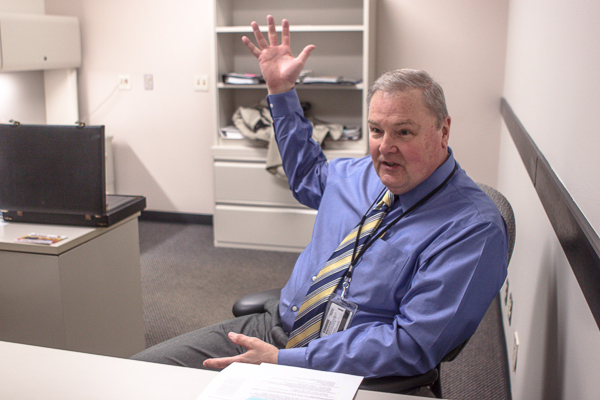
Alan Lecz prepares for his new role as director of the upcoming Advanced Transportation Center, hoping to solidify Washtenaw Community College as a ‘key player’ in the developing industry. EJ Stout | Washtenaw Voice
By PAULETTE PARKER
News Editor
With experience in the aerospace industry in California and 36 years at Ford Motor Company in powertrain engineering, Alan Lecz is ready to take on his next task as the director of the upcoming Advanced Transportation Center at Washtenaw Community College. Lecz will serve as the point person for the center, helping to build WCC’s relationships with companies in the automotive industry.
“We want to have a strong, continuing relationship with business and industry,” Lecz said. “The faculty have got great relationships already with Ford, GM and other local companies. So I’m just going to enhance that and maybe expand it.” Lecz is also bringing his own existing relationships on board.
“I have relationships with the Society of Automotive Engineers. I’m on their academic panels and so forth,” he said. “So I’ll bring that relationship, because that’s important for the Transportation Center to get exposure and recognition in other parts of the industry, professional societies and so forth.”
With the field of advanced transportation systems emerging, Lecz’s experience in its roots is invaluable.
“We went to, years ago, from carburation and conventional ignition systems into electronic-controlled computerized engine controls, and I was part of that first wave at Ford Motor Company,” Lecz said. “So that’s really where my background was.”
A graduate of the University of Michigan in aerospace engineering, Lecz worked in the aerospace industry for three years before going to Ford.
“I was working in California on Douglass DC-8s, 9s and 10s, working on their auto-flight controls,” Lecz said. “I would say it’s 30 years in advance of what ground vehicle things are working on today, because obviously these things control the airplane through the air and right to landing.”
This will not be Lecz’s first stint at WCC. After retiring from Ford in 2007, Lecz came to WCC as regional director of a community-based job training grant, a position he held for three years.
“I really enjoyed it,” Lecz said. “I found it difficult to depart.” Most recently, Lecz spent time in workforce and talent development, working with the other nine community colleges in Southeast Michigan under the Workforce Intelligence Network.
The Advanced Transportation Center will focus on three key pillars: intelligent vehicle systems, advanced manufacturing, and advanced servicing and diagnostics.
“There’s such an interconnection between intelligent vehicles, auto body servicing and repair, and advanced manufacturing,” Lecz said. “All of them will contribute to the workforce demand that’s out there by businesses and industries. So we see this as a really bold move by Washtenaw to really be a key player in helping industry move forward.”
Between retiring “baby boomers” and technology that is constantly evolving, training technicians with the abilities and knowledge to work with this technology will be vital.
“Today, to go into a dealership, I think it’s very difficult for them to find the technicians to diagnose these really elaborate connected systems,” Lecz said. “So there’s going to be a need for more skills for those body areas and the service areas of these dealerships. And this is just exploding.”
In his final years at Ford, Lecz spent time visiting high schools recruiting new engineers. He recognizes that there is a task ahead in getting students interested in these fields.
“I was bringing engine components and talking to them about how we design and develop those things,” he said. “There’s so much technology that’s moving so fast, and the pipeline is not filling fast enough.”
With the $4 million skilled-trades grant WCC received from the state of Michigan, state-of-the-art equipment will be moved into WCC gradually, with some equipment being available for the classes beginning this coming fall. It will take approximately a year to receive and install all the new equipment, Lecz said.
“It’s an exciting time, and there’s so much product development that’s going on,” Lecz said. “If we can feed our technicians into that process, and feed other technicians to go on and get into an engineering program, we’re really serving our own economy by doing that.”
comments
Sofia Oganezova Staff Writer WCC is moving forward with plans to update its website as…
Sofia Oganezova Staff Writer As Ann Arbor heads into the upcoming mayoral election, housing affordability…
Sofia Oganezova Staff Writer The Muslim Student Association at WCC is working to build community…
Sofia Oganezova Staff Writer The effects of the ongoing war are being felt far beyond…
Yana McGuire Deputy Editor During the first week of May, WCC will join millions around…
Sofia Oganezova Staff Writer Before becoming an astronaut, Aisha Bowe was told by a high…