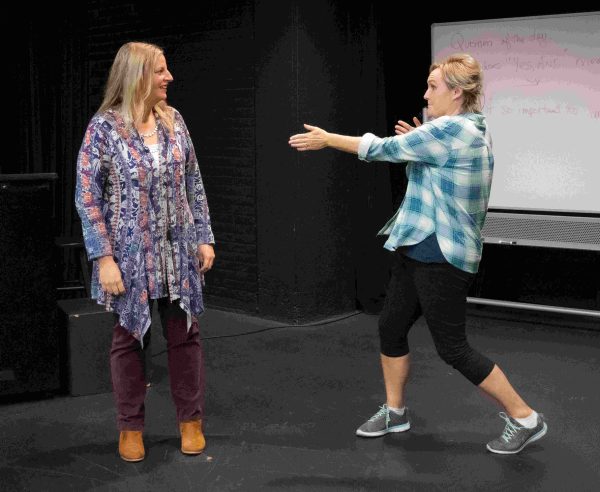
Claire Sparklin, a WCC communication professor (left), receives a zip from Hope Bernard, a WCC theater professor (right), as part of an exercise called zip, zap, bop. Courtney Prielipp | Washtenaw Voice
Hope Bernard shares insights on mental health and the theatrical benefits
Charlie Trumbull
Staff Writer
Improvisational acting is a theatrical technique in which actors perform without a prewritten script.
“None of it is planned ahead of time, [it is] all spontaneous and created right there in the moment,” WCC’s improv acting professor, Hope Bernard, explains.
Hope has a PhD in theater and says she knows “a little bit about everything” in the profession. Her introduction to improv came when she began observing and participating in the scene before realizing that it was the style she wanted to teach in her career.
Since then, Bernard has developed a philosophy in which she closely connects improv and positive mental health. When she first began teaching at WCC in 2022, she saw students who were tired after living through years of a pandemic. For Bernard, improv is a kind of transition between “the anxieties of the pandemic, just our world, capitalism. Improv class is… where we can collaborate with others and sort of rehearse life.”
Rehearsing life can often look like building a community through a small improv class size or practicing saying something wrong. Bernard is dedicated to breaking down social anxieties around feeling safe in a shared space. She said, “In the world we don’t know who’s gonna be safe out there. Improv, in terms of mental health, is a great safe space to learn more about ourselves and others.”
In fact, improvisational acting is not only for stage performances. It is commonly used in many therapeutic forms. Some forms of therapy use improv to teach patients about new things, trying out a new activity, and embracing anxieties that may otherwise cripple social interactions. “It’s not [always] performance based. It’s just like doing it for the sake of doing it… Going through the exercises is sort of like playing,” Hope explained.
Bernard believes the hardest part of taking an improv class is getting over the hurdle of nervousness and fear and taking the first step by enrolling. “That’s a huge step,” she said. “I applaud [students] for doing that.”
Her favorite part of teaching is creating a class culture in which students feel valued and become comfortable taking risks. She wants everyone to feel comfortable coming out of their shell and gaining pride in their performances.
For anyone who is trepidatious about enrolling in Bernard’s improv class, she would like them to know that “the rewards are going to outweigh any sort of nervousness that so many people have. You should think of it as trying out something new.”
Those interested in experiencing an improv performance, this semester’s Improv Jam is on October 31. Attendees are encouraged to participate in improv exercises that may add a new small joy to their lives.