Faculty, students discuss changes happening within federal government
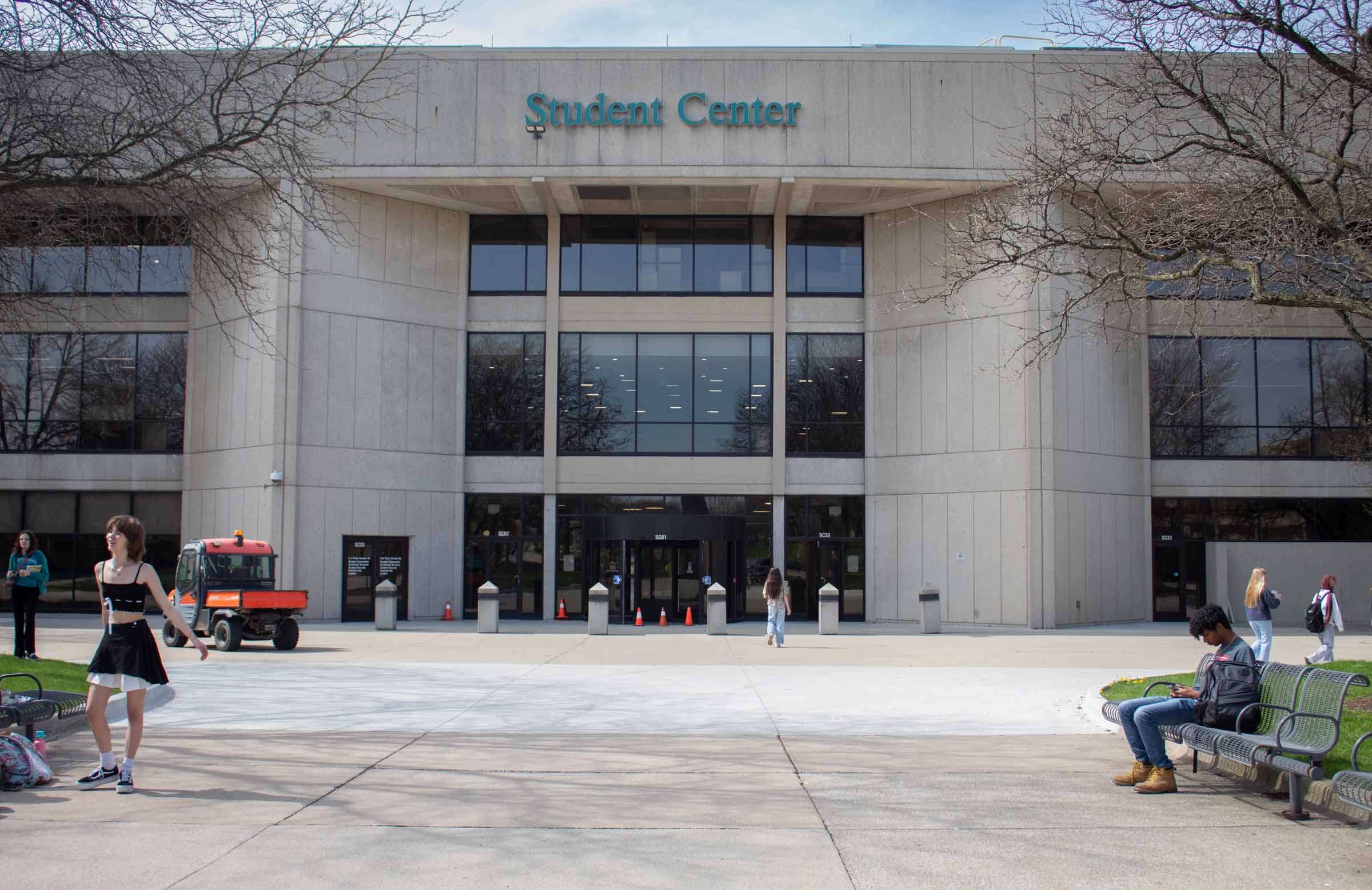
The Student Center, where students are welcome to get food, study, converse, or participate in the myriad of resources WCC offers. Lily Cole | The Washtenaw Voice
Teresa Quinones and Lily Cole | The Washtenaw Voice
The Trump Administration abruptly reversed the cancellation of over 1,500 student visas on Friday, April 25.
Ever since the Trump administration ended restrictions on immigration arrests at sensitive locations such as schools and churches at the beginning of 2025, its focus on mass deportations and border security has emerged as a concerning topic for international students in educational institutions across the country.
When F-1 visas of international students began being quietly revoked without directly notifying the students or their universities, according to an April 4 report from the Associated Press, that concern only rose.
In the past month, international students across the nation have experienced multiple changes to their Student and Exchange Visitor Program (SEVIS) records and visa statuses, including revocations and restorations, leading to widespread uncertainty.
What is an F-1 Visa? What are SEVIS records?
According to the Detroit Free Press, there are three types of student visas–F, J and M–based on the course of study and type of education. An F-1 student visa is a nonimmigrant student status given to students who are studying at a U.S. accredited university or college, or to those learning English at an English language school. An F-1 student visa gives students eligibility for on-campus or study related work. A visa status is reflected in SEVIS records
Inside Higher Ed defines SEVIS as a records system that allows international students, including alumni, to stay in the United States. If a SEVIS status is terminated, it generally means the individual loses the right to remain in the country. However, they can apply for reinstatement.
In the past three weeks, most students who experienced a change in their SEVIS status followed advice from the Trump Administration or their own colleges, choosing to self-deport, stop attending classes or work, or apply for reinstatement.
Impact on the state of Michigan
Altogether, 77 international student visas had been revoked in the state of Michigan, according to Inside Higher Ed.
The same study states that visas were revoked for two international Eastern Michigan University students. International students from several universities throughout Michigan are experiencing this, including the University of Michigan, Grand Valley State, Oakland University, Saginaw Valley State University, Central Michigan University and Michigan State University.
Michigan State University (MSU) announced it was aware of 12 international students’ revoked or terminated visas.
As of April 25, The State News, MSU’s student newspaper, reported that four international students’ terminated visas had been reinstated. However, the number of MSU students whose visas have been revoked versus their SEVIS status terminated remains unclear.
What is happening at WCC?
WCC’s Provost and Chief Operating Officer, Linda Blakey, reported that no WCC student visas had been revoked as of April 29.
According to Peter Leshkevich, the WCC dean of enrollment management and student experience, there were 217 international students enrolled at WCC in the Fall 2024 semester and 223 in the Winter 2025 semester. As of April 14, there are 226 international students enrolled in the Summer 2025 semester.
Via email, Leshkevich reported that 56 F-1 visa students were enrolled in the Fall 2024 semester and 63 in the Winter 2025 semester. As of April 14, 22 F-1 visa students specifically requested to register even though Summer is a vacation term and registration is not required.
Are the tides for visa revocations changing?
As of April 25, federal judges nationwide have released orders to restore student records in SEVIS.
As shown by Inside Higher Ed’s statistics, 1,840 students and recent graduates from more than 280 colleges and universities reported changes in SEVIS records.
Colleges like Harvard University, Rice University, Stanford University, Tufts University, the University of Nebraska at Lincoln and the University of California, Berkeley, have also shared that while some students have experienced visa changes or the restoration of SEVIS statuses, others remain terminated.
What do international students think?
International students all over the United States are expressing concern over being deported or arrested for expressing their right to free speech over their political views. Many are censoring what they put on social media, have stopped attending classes or work and are not speaking out like they used to in public settings.
WCC’s international student advisor, Devin Streur, has worked with WCC international students for 10 years and an additional five at Grand Valley State University.
Streur explains that he often only sees students when they are registering for classes. The last time he spoke to some students was before the administration’s reversal, so “it’s difficult to know exactly where a lot of them are at,” regarding knowledge about the reversal.
Streur said that “a lot of them (international students) are fearful of going home for the summer,” and “It’s more so creating a sense of fear and uncertainty for them and just not wanting to do anything that’s going to draw attention to them or jeopardize their status in any way.”
“It’s pretty sad that returning home to see family could possibly jeopardize status,” Streur said.
Hartej Singh, a nursing student at WCC, has attended the community college for four or five years. Although he is classified as an international student, Singh shared that recent visa revocations do not affect him personally.
“My concern is for people who have moved to the States for protection. I hope they get a green card,” said Singh.
Singh was not aware of the recent news about SEVIS records and visa statuses being restored. Once informed, he shared his view on the matter.
“If they’re getting reinstated, that’s really good. They shouldn’t have gotten them taken away in the first place,” said Singh.
Mahdeea Khan, a WCC international student studying pre-engineering, has attended WCC for two years.
Like Singh, she explained she was born in the United States and that recent news has not affected her plans for school, work, or staying in the U.S. However, she shared concerns about the broader impact of revoking visas for international students.
“We have the right of free speech,” said Khan. “Although this country promotes this, censoring and revoking student visas is kind of not really allowing them (students) to have free speech or express their opinion.”
After receiving recent news of the restoration of visas, Khan reiterated that “people view America as the land of opportunity.”
“You got these students from different countries coming to get an education. The government was going to get backlash anyways,” said Khan.
Message from Public Safety
To his knowledge, WCC’s Chief of Public Safety, John Leacher, reported that Immigration and Customs Enforcement (ICE) has not made an appearance on campus, as of May 13.
For students worried about their immigration status, Leacher restates Public Safety’s mission.
“Our job on campus remains the same as your public safety department, which is to make sure that you have a safe environment, to do what you’re here to do, which is get an education,” said Leacher.
One Reply to “Impact of immigration policies on WCC community”
Comments are closed.