
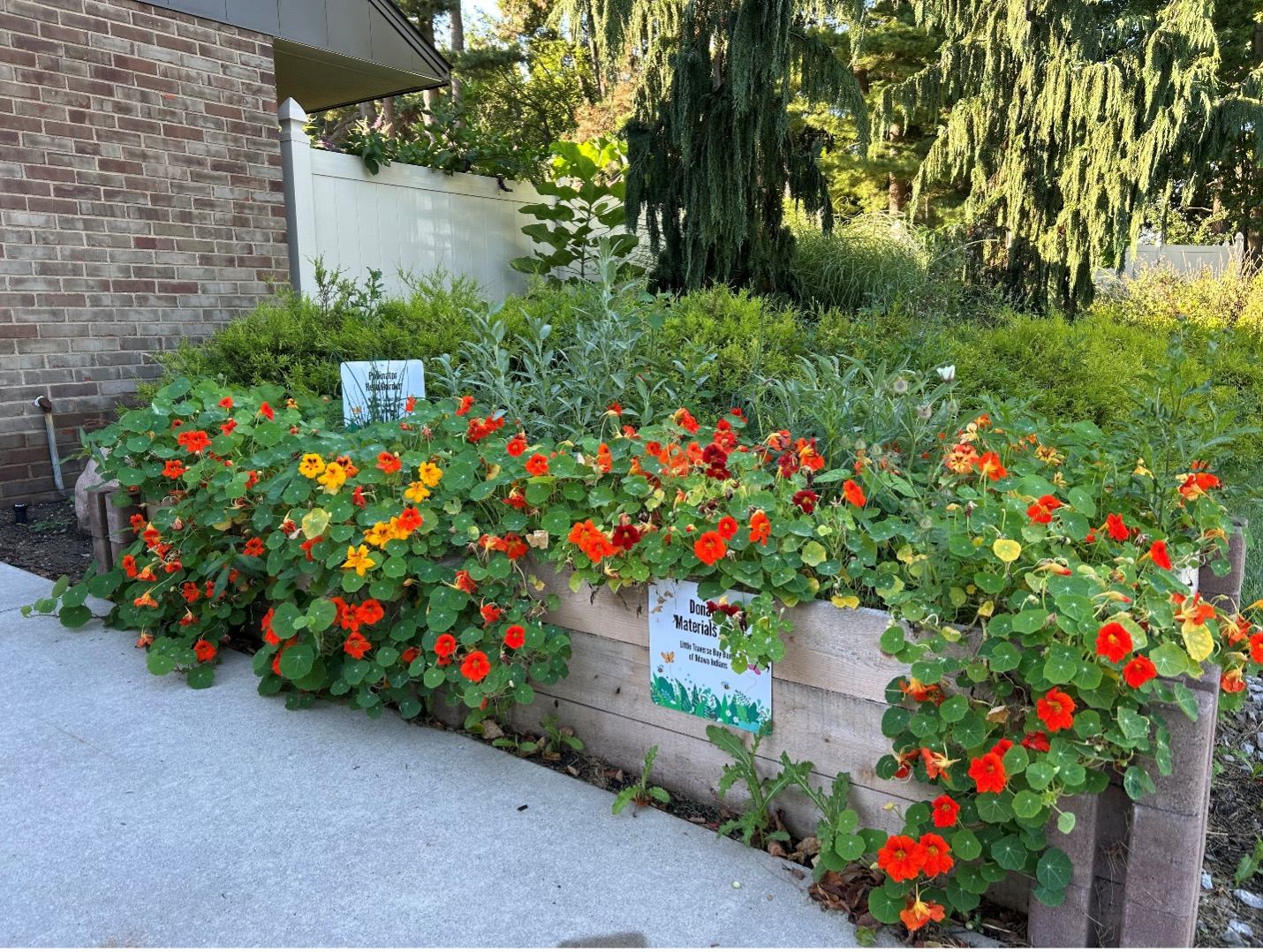
WCC’s native pollinator herb gardens support bees and butterflies while promoting sustainability on campus. Courtesy of Sandy Mccarthy.
Sofia Oganezova | Staff Writer
As winter snow melts from campus, two native pollinator herb gardens planted earlier this year reflect Washtenaw Community College’s continued commitment to sustainability, accessibility and environmental education.
The gardens, planted in April and May 2025, are located around the giant rock behind the Liberal Arts and Gunder Myran buildings and in a raised bed near the Family Education Building.
Pollinator gardens support Bee Campus USA initiative
The project aligns with the Bee Campus USA initiative led by the Xerces Society, which recognizes colleges that enhance pollinator habitats, reduce pesticide use and educate their communities.
WCC has now been recognized as a Bee Campus USA affiliate for the sixth consecutive year.
“It’s part of the campus sustainability initiative. It’s about being friendly to pollinators and rethinking how landscaping is done on campus,” said Sandra McCarthy, faculty librarian and co-chair of the Bee Campus USA-WCC committee.
Pollinators play a critical role in global food production and ecosystem health. Bees pollinate more than one-third of the world’s crops, including fruits, vegetables and livestock feed such as alfalfa and hay. Because bees rely on nectar for carbohydrates and pollen for protein, creating environments rich in native flowering plants is essential to their survival.
The new herb gardens were designed to do exactly that.
Students help design and plant native habitats
Beyond ecological benefits, the gardens serve as visible learning spaces.
“Students stop by these gardens and just observe and watch what goes on,” McCarthy said. “I think it’s educating most of all. People are really interested in this topic. Students come to these programs.”
The designation also carries weight across the state.
“We might be the only community college in Michigan maintaining it right now,” McCarthy said.
Planning for the gardens began in fall 2024. Members of the Bee Campus USA Committee, the Center for Sustainability and Resilience, the Sustainable Literacy Task Force and the Students 4 Sustainability club collaborated on the concept. The garden design itself was created by Center for Sustainability & Resilience work-study students.
Gardens serve as learning spaces for sustainability
“Anything we do is service learning. If we did everything ourselves, the students wouldn’t learn,” McCarthy said. “It’s very important to have students as part of these projects.”
Students researched and ranked native plants, organizing them by height and ecological fit before final selections were made.
“There was a lot of background work to the final list: ranking plants by height and how they’d fit around the rock,” McCarthy said.
The Big Rock site was selected intentionally. Rather than focusing solely on plant availability, planners considered infrastructure and long-term maintenance.
“It wasn’t so much about difficulty sourcing the plants — it was more about choosing the right location,” McCarthy said. “We wanted a space that had irrigation, sun and visibility — not tucked away.”
Positioning the garden in a high-traffic area allows it to function as both habitat and educational display. Signage designed by a WCC student identifies the plantings and their ecological role.
The raised bed near the Family Education Building was constructed from locally milled cedar wood donated by Ziibimijwang, Little Traverse Bay Bands of Odawa Indians, with WCC Facilities preparing the materials and S4S students assembling the structure. The collaboration grew out of a search for indigenous herbs and local partnerships.
“We were looking at indigenous herbs, and that led us to working with a Native American group,” McCarthy said. “It’s important — working with native plants and working with Indigenous groups — you’ll find that in all sustainability efforts.”
The plant selections reflect that focus on native and pollinator-friendly species. Near the giant rock, varieties include witch hazel, black currant, white sage, bee balm, yarrow, sweetgrass, yellow and purple coneflower and wild geranium. The raised bed features white sage, nasturtium, yarrow, nodding onions, American ginseng and poppies. Soil used in both gardens is pesticide-free.
Weather and seasonal conditions were part of the planning process. The gardens were planted on April 23 and May 22, 2025, dates chosen to balance spring temperatures and planting readiness. Irrigation systems already in place at the Big Rock site reduced the need for additional watering infrastructure and helped ensure plant survival through summer heat.
Campus Partnerships expand environmental efforts
The gardens represent more than landscaping upgrades. They connect to broader sustainability initiatives on campus, including the seed library housed in the library and ongoing pollinator education efforts.
“I’ve always liked gardening,” McCarthy said. “That’s really where it started.”
That personal interest evolved into institutional action.
“You have a seed library, you give out free seeds, you empower people to grow their own garden — it’s social, it’s food justice, it’s a learning experience,” McCarthy said.
For students involved in the project, the impact extends beyond coursework.
“When you leave campus, you feel like, ‘I was part of that.’ Even if your name isn’t there,” McCarthy said. “It’s also a big connection with students.”
While winter brings freezing temperatures and snow to campus, the gardens will enter dormancy. Their presence, however, signals a long-term commitment. By combining native plantings, reduced pesticide use and student-driven design, WCC continues to build habitats that support pollinators while embedding sustainability into campus culture.
The two herb gardens are intended not only to attract bees and butterflies but also to invite observation, conversation and participation. In doing so, they reflect a broader institutional goal: cultivating ecological awareness alongside academic growth.