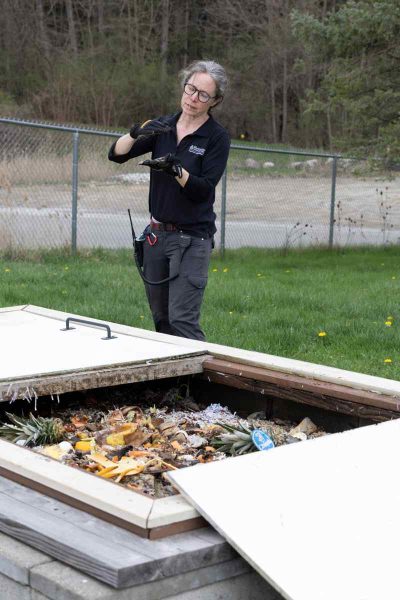
Becky Andrews, WCC’s Resource Recovery Manager, explaining the process of the organic matter compressing down as the worms process the materials. Even though they haven’t been harvested for two years, the worms are still active. Dalaina Denard | Washtenaw Voice
Yana McGuire
Deputy Editor
During the first week of May, WCC will join millions around the world in celebrating contributions towards making the world a healthier place to live.
The Washtenaw County Board of Commissioners passed a resolution declaring May 3 through May 9 as International Compost Awareness Week, ICAW, during the April 15 board meeting. To recognize local efforts towards sustainability, the Water Resources Commissioner’s Office & Public Works, along with other organizations, will be hosting events each day to help residents learn more.
On May 8, the celebration comes to WCC’s vermicompost system, or worm farm, during its harvest season. A tour of the grounds where the worm farm is held and the garden where the compost collected from the farm is used will be hosted by Becky Andrews, WCC resource recovery manager. Anyone interested is welcome to come. The event will run on a weather-permitting basis.
All events coincide with The Compost Research & Education Foundation, CREF, ICAW’s extensive education initiative that is celebrated in more than 40 countries every year.
This year’s theme is “Compost! Feed the Soil that Feeds Us.” It was picked to align with the United Nations Sustainable Development Goal “Life on Land,” which focuses on conserving life on land by protecting and restoring ecosystems, according to CREF’s statement.
Theo Eggermont, director of public works, believes that this event and others will help people understand some ways to improve the environment and how they could get involved.
Having owned a red wigglers bin or mini farm in college, Eggermont knows the hard work Andrews and her team puts into the system and is excited that the experience is being shared.
“It’s a really fun way to turn something that could be a waste product and turn it into something that’s just a really condensed, nutrient dense soil input,” Eggermont said.
Vermicompost farm at work
In 2016, WCC’s Recycle Operations Department installed 10,000 red wigglers worms into a pit that is two feet into the ground. A second pit came in 2020 due to the rapid rate the worms reproduce.
“[The pits] are lined with chicken wire, so if the worms want to leave, they can leave,” Andrews said. “There’s nothing making them stay, other than they’re getting free food.”
Pre-consumer food waste, or in other words, kitchen scraps that have not been heated or cooked are collected from all over campus and emptied into a pit filled with worms. Even though the worms can eat just about anything organic, the foods that make them the most happy are fruits, vegetables, eggshells, tea and coffee, according to Andrews.
Each worm can eat more than their weight each day, making them ideal for farming.
During digestion, the worms condense most of the nutrients from the food waste into castings. The castings are then harvested and filtered to make organic fertilizer.
Environmental impact
Recycling kitchen scraps in this manner reduces methane emissions from landfill waste. 30% of the increase in global temperature is due to methane, according to The International Energy Agency. Reducing its emissions could help fight climate change.
“It [vermicompost system] recognizes the natural processes that can turn our waste materials that we create into something that goes back into the earth — that’s healthy and productive,” Eggermont said.
How to get involved
For people unable to attend any of the compost week events, Andrews encourages anyone who is interested to email her at rjandrews@wccnet.edu. She is offering tours beyond the week’s celebrations and is willing to share her knowledge.
Washtenaw County food scrap drop-off pilot allows residents to drop off kitchen scraps for composting. The cities of Ypsilanti and Dexter and Salem Township currently have pilot sites, but the exact location has been reserved for participants. There is a limited amount of space for participants to join. Anyone interested in joining can fill out an application provided on the county’s website.
“We have choices about what we do with the [waste] materials that we create,” Eggermont said. “We can either put those into something that’s not productive and oftentimes harmful to the earth, or we can put it into something that is regenerative and productive. It’s awesome when institutions or individuals choose to do the latter. So it’s something to celebrate and be
excited about.”