It’s ‘The Real World’

Title: When people stop being polite and start getting real

Addie Shrodes

Editor

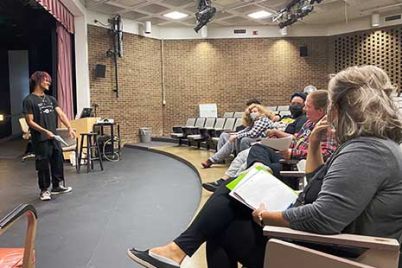
Students sitting at a table

CHRIS ASADIAN THE WASHTENAW VOICE

An anxious crowd gathers purposefully around the entrance to Ann Arbor’s Bistro Bar and Grill, not daring to pass through the heavy wooden doors until called upon. Just outside the idolized entrance, a small pop-up tent hosted by Detroit’s AMP Radio pounds All-American Rejects. Underneath, a coordinator hands out doughnuts, pens — and applications. This is an interview, but not for a job. It’s “The Real World” auditions for the MTV show’s 24th season. Arguably the original reality show, “The Real World” sends seven or eight strangers ages 18-24 to a different location each season for five months and tapes around the clock. They live together, are given part-time jobs — and hearty access to booze — and the show pastes together the often-dramatic results. Three to four casting teams travel the country in six-weeks hosting 12 open auditions, explained Kasha Foster, the casting director who led the Ann Arbor auditions from 10 a.m.-6 p.m. on Tuesday, Oct. 20. The teams look for people to stand out in a short 10-person-group interview. “We’re always looking for people who are curious about others, curious about life, just interesting people with a little charisma,” Foster said.
Student filling out an application

CHRIS ASADIAN THE WASHTENAW VOICE

Student being interviewed

CHRIS ASADIAN THE WASHTENAW VOICE

Student waiting in line

CHRIS ASADIAN THE WASHTENAW VOICE

By 3:30 p.m., about 250 people showed up, and Bistro Manager Scott Henman expected to have 500-600 by the close of the day. “Everyone looks fresh-faced and excited, so that definitely makes it easier,” Foster said. The teams review video auditions and narrow down the candidates before choosing the final cast. “You meet so many interesting people, and you know everyone has something about them that makes them special,” Foster said. Smokin’ Escape With a sleek build clothed in a cherry-red jacket, high tops and tank, Jodie Walden seems adept and undaunted. A crystal-studded buckle holds tight jeans purposefully below matching red briefs. But a corner smudge of meticulous eye liner hints at a dispirited individual who wants friends, wants purpose — wants to get out of here. A once-troubled individual who was sent to “Judge Judy” at 16 for keying her ex-friend’s car, Walden works at Race Track, her sister’s bar in Clinton, and lives with her parents and boyfriend of four years in Ypsilanti. The 22-year-old auditioned for “The Real World” because the show would give her what her life lacks. “It’s like meetin’ a family,” Walden said of the show. “I don’t have any friends basically; I got my boyfriend and that’s it.” Walden also wants to find a purpose beyond bartending. “I just want some-in’ new — I feel like I’m meant for more than this,” she said as her watery blue eyes scanned the scene. Her long-term relationship is one of the reasons Walden wants the new experience. “I love my boyfriend to death, but I don’t know how it would play out,” she said. “Being with someone, it’s going on five years, you kind of get dependent on somebody, and I want to see how’ll I’ll be without him.” Enthusiastic Emo A smile full of naïve optimism marks a fresh high school graduate from a town of less than 2,000 people. Don’t let the large ear gauges and pale-orange hair poking out of a beanie fool you into thinking he’s a punk. Taylor Louchart is as bubbly as the chestnut freckles radiating from the center of his nose. “By looking at me, people automatically think, ‘aw, hoodlum,’ but I’m really not — I’m like a giant teddy bear,” the 18-year-old from West Branch said with a hearty smile that dimples with metal cheek studs. Louchart, who aspires to attend fashion design school in San Francisco, doesn’t want to get on “Real World” for the fame or the drama; he just wants new adventures. “I was born in a small town — it’s not my fault,” he said. “I’m very worldly and I know all that stuff, but I haven’t had much of a chance to engage in it a lot.” But he doesn’t want to engage as much as he might claim; he backs down from conflict, even though he talks a big game. “I say, ‘If there’s a fight, I’m gonna get up in there,’” he said exaggeratedly. “But really, I just kind of back down. No drama for me.”
Students sitting on a curb

CHRIS ASADIAN THE WASHTENAW VOICE

What a Chance As he lies on the sidewalk with a “Real World” application, what stands out about Julian Rashad (pictured left) is his fly white sunglasses and glossy red sucker. But it’s his gray sweater vest that brought him to the auditions. He hadn’t planned to go, but he dreamt about the auditions the night before and woke up deciding he would if he got one more sign. “I’m just like, Lord give me a sign,” the 19-year-old from Rochester said. “I was looking all over for this shirt that I wanted to wear today, and I couldn’t even find it, and then all of the sudden it was sitting on my bed this morning, and I’m like, ‘alright, that’s a sign.’” He said his extended family “would be haters” of him going on the show, but they were even unsupportive when he got a part-time job at Brilliant Sky Toys and Books. “I just definitely got more haters than people who want good things for me,” he explained. He feels like the show is a place where he can be himself, as his life can conflict with his religious upbringing. “Nobody’s a perfect person — I’m a Christian, but I party and I cuss and shit,” he said as he caught himself and chucked embarrassedly. “But, I mean, it’s alright.”
Student smoking

CHRIS ASADIAN THE WASHTENAW VOICE

Student filling out a form

CHRIS ASADIAN THE WASHTENAW VOICE

Student shadows

CHRIS ASADIAN THE WASHTENAW VOICE

Get Real Honestly is paramount for Bryan Cajamarca, who radiates charisma with long-lashed brown eyes and a dimpled smile. Why not live in the ultimate realm of candor, reality television, and open a gateway to his dreams? Raised Roman Catholic, Cajamarca, 19, told his family of his bi-sexuality two years ago because he wanted them to embrace him in his entirety, he explained as he toyed with the rosary beads around his wrist. “If they were going to, in the end, come around and still accept me, then I know they’re always going to be there for me,” he said. “But if things end up on the rocks, that will show me how it really is.” His parents kicked him out of the house initially, but the situation improved, although “it’s still always causing conflict.” A broadcast journalism major at Macomb Community College, Cajamarca has done theater acting since high school, and his ultimate goal is to be a professional actor. His parents don’t want him to share his entire life on television, but “that’s not their decision,” he said with a chuckle. He believes it’s just as important to be honest and television as it is in life. “I want to tell everything about me, because a lot of people watch the show and love to say, ‘I know exactly what they’re feeling — I know what they’re going through,’” he said. School of Hard Knocks An ambitious accounting student at Eastern Michigan University, Tiffany Deloney sees “The Real World” as a way to propel herself farther from her difficult past. After Deloney’s mother died when she was 10, she and her seven brothers lived with a father they didn’t know. The 23-year-old moved from Flint to Ypsilanti when she was 17 to get away from her father and attend Washtenaw Community College. She works at Citizen’s Bank to help put herself through school, and, as the oldest of eight kids, helps support her brothers, who now live all over the country. But she still has to take out thousands in student loans. “Sallie Mae will be callin’ me soon,” she said as she smiled to reveal similarly expensive braces. She will graduate with a bachelor’s degree in December, and plans to start a master’s program at EMU next fall. She wants to open a business and do accounting for celebrities, and she hopes she would be able to make connections on “The Real World.” “I think it would give me a lot of opportunities,” she said. Her tweed jacket paired with a camouflage hat and glittering gold hoop earrings reinforce her unconventional approach to business. Serial Spree A self-described weird party girl, Nicole Adair came to the “Real World” auditions with her best friend on a whim. It was close to her hometown of Ypsilanti, and the 20-year-old would rather be on “Real World” than a dating show, “because those girls all look like sluts.” Her life is interesting enough. “We should always have video cameras following us,” she said of herself and her friend as she smiled widely and pushed back a piece of frizzled bleached hair. “We party a lot, and all this crazy stuff happens to us. On our way here, this lady got out of her car and threw a hub cap off of her car onto oncoming traffic.” Adair’s studying at Washtenaw Community College for an associate’s in criminal justice, and wants to be in the FBI. She is especially interested in murder cases. “I’m a big fan of different serial killers,” she said matter-of-factly as she adjusted her black-framed glasses. Her favorite? The “Night Stalker” Richard Ramirez, who murdered 13 Californians in 1985. Prove to Music A black baseball cap pulled sideways around Abe Boumelhem’s fire-scarred face doesn’t hide his joyous eyes. An accident when he was 7-months-old left his face and left arm disfigured, but that hasn’t slowed him down — and he wants to prove that to everyone. “I want to show people all around the world that I can make it in the real world,” he said. Boumelhem, 20, is a surgical technology student at Baker College, but he is also an award-winning singer and dancer with the artist name “Royal.” He has been on the Detroit dance show “D Party,” and is producing his first album titled “The Pain,” which he describes as radio-ready dance R&B. He wants to promote his celebrity on “The Real World” — and drop names of those he’s hung around, such as the Ying Yang Twins, Akon, Lady Gaga and Jermaine Dupri. Interviewed by local television crews at the auditions, Boumelhem never misses a moment to prove his success and bolster his name. But his talent comes from more humble roots. He started to learn singing and dancing from his mother at the age of three. “I always did karaoke with her, and growing up with her, it’s like okay, this is something I really want to do,” he said.

Instructor tips: What to look for and ignore at ratemyprofessors.com

Instructor tips:

What to look for and ignore at ratemyprofessors.com

Addie Shrodes

Editor

Not all instructors sign off on ratemyprofessors.com, but they have some tips for what students should look for. Most agree that students should key in on the teaching style that works best for their learning style, so paying close attention to the site’s comments is important. Clarity and helpfulness, however, were the most highly regarded points of evaluation for most instructors. “Clarity is a big thing for me, and helpfulness,” said English instructor Julie Kissel. “Students want to connect with their teacher, and if they don’t feel like they’re helpful, they may not approach them.” Easiness is the category most disagree with. “Don’t be fooled by the easiness score,” Kissel said. “Easy doesn’t always mean good.” If an instructor is skilled, ease will be irrelevant. “If you have a really good instructor, don’t worry about whether they are easy or not,” said Mathematics instructor Mohammed Abella. “If they teach you the right procedures, it doesn’t matter if the problems are easy or difficult.” Since the easiness score contributes to an instructor’s overall quality score, Mathematics instructor Mark Batell thinks it diminishes the site’s value. “Some students tell me that they go there religiously to pick their teachers, and it’s like, ‘Why would you want somebody easy?’” he said with a baffled laugh. “ . . . If the goal is to learn something, then easy/hard has nothing to do with it, and what’s easy for one person could be hard for the next. If that’s what gets higher ratings — if it’s easy, then we’ll create an idiocracy.” But the amount of work can also be a point to look for if a student is having a busy semester. “Let’s just say you have a chemistry class and trig — you may not want to take somebody who’s going to lay five papers on you in psych,” George-Sturges said. “I guess in reality, a lot of students are looking for easy instructors,” said Life Sciences instructor Ross Strayer. The hotness category, identified by chili peppers, is the most inappropriate — and amusing — category for instructors. “I even have peppers on there, and you know, some poor person’s going to come in and expect a hot teacher and here I am,” Strayer said as he chuckled. “I guess it maybe makes it fun or something.” “The chili peppers is the weirdest thing,” Kissel said. “Just the idea of rating the hotness I just find humorous more than anything. Maybe that is the piece that is not terribly appropriate, in terms of an instructor site. But if it makes it fun and interesting to read, then alright, we’ll have chili peppers.”

Instructors sound off on ratemyprofessors.com

Instructors sound off on ratemyprofessors.com

Faculty view popular student site as helpful, but problematic

Addie Shrodes

Editor

ashrodes@wccnet.edu
Information graphic showing how select Washtenaw Community College instructors stack up
A Web site where students can read informal evaluations of instructors has become, at least for some students, as necessary to check before class registration as the course catalog. Though relatively few students submit reviews to evaluate easiness, helpfulness, clarity, quality and — ahem — hotness, many students flock to ratemyprofessors.com to read the good and bad, and choose their classes based on fellow students’ responses. But what do instructors think of the site? The Washtenaw Voice spoke with six Washtenaw Community College instructors familiar with ratemyprofessors.com to get their assessment of the popular student site.
Good, bad and in-between
Full-time Behavioral Science instructor Cassandra George-Sturges recommends the site to students and her kids. “I always tell my kids to do it, and if a teacher is new and isn’t on there, I say don’t take ’em,” George-Sturges said while laughing. “But only if it’s in a subject you’re not good in. If you’re good in math, it doesn’t matter who the teacher is, you’re going to excel; if you know that you hate history or you’re not good in chemistry, that is when ratemyprofesssors.com is so necessary.” On the other end of the spectrum, Mathematics instructor Mark Batell, who teaches developmental math and algebra, believes the site has no value because it is a personality contest that can’t truly evaluate teaching style. “It doesn’t matter if (instructors) are funny or friendly, you just have to know they’re delivering,” he said. “Students really, and I don’t mean this in a derogatory way, but students are really not in a position to know what’s good for them. Think about parenting: you don’t do what your kids want you to do, you do what’s best for them.” It should be used more as an indication of whether an instructor might fit with a student’s learning style, suggested many instructors, including Life Sciences instructor Ross Strayer. “A lot of students have told me they use it, and they use it as a gauge,” he said. “If a person has a lot of positive things, they think, ‘well maybe they are okay.’”
Skewed results
One of the main problems instructors identified with the site is that zealous students often skew the scores one way or another. “Not often do you go there and say, ‘Well I kind of liked them,’ or ‘I thought they were okay in the classroom,’” said humanities instructor Dena Blair, who teaches public speaking and broadcast arts. “Usually there’s some strong emotions that are involved with that.” “If a student really likes an instructor, they’ll go there, and if they really dislike an instructor, they’ll go there as a chance to dis them,” Strayer said. And the fewer reviews there are, the more likely results will be skewed. “These reviews don’t mean anything unless there’s a minimum number of reviews done,” said Mathematics instructor Mohammed Abella, who suggests a minimum of 20 reviews for full-time instructors and 10 for part-time instructors.
Accurate — for a student review
Most of the instructors do find their reviews to be fairly in tune with their teaching style. “Obviously there’s always going to be some weird things on there where people are either going to crucify you or they’re going to make you seem like the God itself, but I think there’s a consistency,” said English and writing instructor Julie Kissel, who teaches developmental classes. “It’s like a puzzle: If you put all the pieces together it’s pretty accurate,” George-Sturges said. The ratemyprofessors.com reviews also match up well with the results of the WCC Student Opinion Questionnaires (SOQ), which the college hands out in classes during the mid-point of every semester. “I think that’s a good measure to see there is that consistency at both a very standardized process as well as something that is very loose,” Kissel said.
Could be better
Of course, the site could be more helpful for students and instructors. “I wish on ratemyprofessors they would ask for weaknesses,” Strayer said. “. . . It would be better if they broke it down to weaknesses and strengths. My weakness on the SOQs is I don’t talk loud enough, so I got a microphone, fixed it and it was helpful.” “It’s an interesting tool to point out certain aspects of an instructor’s teaching style, but not necessarily a great tool to use as an overall evaluation of a teaching style,” Blair said, who added that the site would benefit from additional evaluative categories. Some instructors do view the site as another way to get feedback on their teaching style, however. “I appreciate all the feedback,” Kissel said. “Some teachers don’t want any feedback and want to assume that they’re doing the right thing, and if students don’t get it, it’s their problem, and that’s not always the case. Certainly students have part of the responsibility, but so do I, and I have to be able to reflect on that as well.” Having another approach, Batell doesn’t pay attention to any kind of review system by principle. “What we do now gets in student’s ways, and if we give them too much control, and I don’t mean this in a derogatory way, but we don’t want the lunatics running the asylum,” he said. “So I frankly never pay any attention to any of that — it would interfere with what I think is best for them.”
Alternatives to ratemyprofessors.com
Many instructors suggest visiting faculty office hours before registering for a class as an alternative or supplement to ratemyprofessors.com. Speaking with the instructor about the course structure, expectations and assignments will give students a good impression of the course and the instructor. “That to me, usually, would be the best way to be able to gauge for the individual student,” Blair said. Better yet, sit in on a class, George-Sturges suggested. “If I were a student, I would ask permission to sit in on a class,” she said. “And it’s really good to talk to the students when they’re leaving, because they’ll be honest. It would only take about 15-20 minutes of your time, but your going to spend four months of your life invested with this person.”

World Cultural Celebration

World Cultural Celebration

Middle Eastern dancer

RACHEL DETHLOFF WASHTENAW VOICE

A joyous Middle Eastern dancer throws up his arms in celebration.

Representative of Tibet at the World Cultural Celebration

MICHAEL WESTHOFF WASHTENAW VOICE

Tibet, including Jumpa in his traditional dress, was represented at the celebration with a display table.
Indian dancer

RACHEL DETHLOFF WASHTENAW VOICE

This dancer displayed bhangra dancing from the Punjab region of India, a 500-year-old tradition. Henna

MICHAEL WESTHOFF WASHTENAW VOICE

Intricate hand paintings, including mehndi henna decorations from India, are an important part of some cultures.
Chinese dancers

RACHEL DETHLOFF WASHTENAW VOICE

Evergreen senior citizen dancers from China, who range in age from 71-90, smile while demonstrating their culture.
Henna

MICHAEL WESTHOFF WASHTENAW VOICE

Dansoa Kagnassiu represented Togo in the World Cultural Celebration fashion show in Towsley Auditorium.

A life behind the Iron Curtain

A life behind the Iron Curtain

Julianne Mattera

Staff Writer

jumattera@wccnet.edu
Elisabeth Thoburn

JULIANNE MATTERA WASHTENAW VOICE

Elisabeth Thoburn saw the Berlin Wall for the first time with her father while on summer vacation. An 11-year-old growing up in East Germany, the Wall that had separated her family from freedom had been a reality for her entire life. “We of course knew without the physical wall that we lived in a very bizarre country because my family was split in half in 1961 when the Wall was built. My father’s relatives were all in the East . . . and my mother’s relatives were all in the West,” said Thoburn, a humanities instructor at Washtenaw Community College. “I just knew they were out there in the big free world, and we were not.” On Nov. 9th, Thoburn will commemorate the 20th anniversary of the fall of the Berlin Wall with a lecture entitled, “Reconstruction and Reconciliation: the 20 year anniversary of the fall of the Berlin Wall,” that discusses the history of East Germany from World War II to present day, focusing on a famous church in her home town of Dresden. Called Frauenkirche, the church became a symbol for people in the 1980’s who were fighting for freedom. The church was in ruins until an international fund-raising campaign helped rebuild the church several years ago. “That’s pretty much the story I will tell—how that church went through the different phases and became a symbol of WWII being bombed, completely bombed; a symbol for the peace movement as it became a center for vigils and prayers; and now after the Wall was down, how it became a symbol for the entire world to pull together,” she said. She will also weave in bits and pieces of her own life and experiences in communist East Germany throughout the talk. “Her presentations are organized, exciting and just make you want to experience more of what’s going on,” said Joan Messer, a student at WCC. “And I think she’s a wonderful lecturer anyway and has such vast information to give that her experience of being an East German would just make it absolutely fabulous.” The church was a heap of rubble when Thoburn was growing up. While she left the country in 1985 after marrying Steve Thoburn, her ex-husband who lived in Plymouth, Thoburn’s family stayed behind. Soon after, more and more civilians began protesting the country’s politics. “Starting in ’85, people had, through the churches, put together groups—people who were interested in peace, people who were interested in gay and lesbians, the environment, reading books that were banned and all of that,” Thoburn said.
Frauenkirche

MARTIN THOBURN COURTESY IMAGE

“So people more and more became politically conscious and also said, ‘We’re no longer doing this. We’re no longer going where this government wants us to go. We need alternatives.’” Growing up in a family of political dissenters, Thoburn and her brothers made sacrifices to stand up against the government and stay true to what they believed in. And she stood out like a sore thumb at an early age. “My father would always wave the constitution and say, ‘There are still rights in here,’” Thoburn said. After returning to school the summer that she saw the Berlin Wall, Thoburn wrote about her trip for a class assignment. “I was just shocked to see that we were walled in and locked up,” she said. “And so I was promptly dismissed from school because I wrote that essay and used all the wrong vocabulary. . . . The communist called this wall not the Wall that we were locked up in but an anti-fascist protection device.” The government controlled what books people could read and what they could say out loud. And even though she received top marks in her classes, the government prohibited her and her brothers from enrolling in higher education. But she says it wasn’t all bad. Crime, homelessness and unemployment were basically non-existent, she said. And people still went about their lives regularly from day to day. Just as Thoburn grew up with the Wall as a reality, she realizes that many younger students at WCC view the Berlin Wall and the Cold War as a thing of the past. And she hopes her lecture will impart a bit of historical perspective. “I want people to ask, ‘Well, what’s the world I live in? What’s the conflict of this world? What do I have to watch out for, and what could my contribution be,’” she said. “I think that it’s important to know that you cannot change the world as an individual but you can make a contribution to the world you live in.”

Officials hold their knows, while students and instructors get sick

Ann Arbor Wastewater Treatment Plant

MICHAEL WESTHOFF WASHTENAW VOICE

Take in a deep breath and enjoy the glorious autumn fresh air around campus. On second thought, you might want to hold your breath. Many evenings, a large portion of this beautiful campus smells like the inside of an outhouse.

“It’s disgusting and bad for the respiratory system,” said Sarah Partlow, 29, of Northville. A nursing student who attends lectures in the evenings, Partlow says she smells sewer gases in her classroom in the Technical and Industrial building.

She is not alone. Many others are annoyed by the smell. Some are getting ill.

“I felt physically sick to the point of nausea from it,” said Peter Stein, 19, from Saline, whose major is digital film and 3D animation. He doesn’t want to go to class because he got sick from the fumes.

“It smells like a septic tank. I think it’s gotten worse since last year,” he said. “It’s so strong it’s like you are right next to (it). I can’t imagine what it smells like at the source. Who knows what type of different diseases could multiply in this cesspool.”

While the odor has been prevalent at certain places around campus the last few years, no one seems to know what’s causing it—resulting in no small amount of finger-pointing around the community.

“As best as we can tell, the smell is coming from Ann Arbor Wastewater Treatment Plant across Huron River Drive,” said Damon Flowers, associate vice president of Facilities Development and Operations. “It’s not the college. This has been an ongoing problem that we have looked into.”

But officials at the Ann Arbor Wastewater Treatment Plant, located just off Huron River Drive, insist the plant is not the source of the odor and that the college may have plumbing and sewer issues it needs to resolve to alleviate the problem.

According to Ed Sajewski, head of Contract and Project Service Management at the wastewater treatment facility, the problem may be a force main coming from the college to the plant.

“There have been no back up or disposal problems at this time on our end,” he said. “We try to be stewards of the Huron watershed and don’t want anyone to get sick. We want to be good citizens and get to the bottom of this.”

The plant invites anyone to make an appointment and take a tour of the plant to show it is not to blame.

Meantime, WCC officials continue to gather evidence to show that the college isn’t to blame, either.

“One problem we have is there have been no known measurements (air samples) previously taken to determine the levels people have been inhaling,” Flowers said.

But that may change soon. Todd Bishop, construction project manager, is negotiating with several testing agencies that do air samplings with canisters.

“We are investigating if there is a problem on our end first before pointing the finger,” Bishop said, explaining that he’s also inspecting the college’s “lift station,” a device that takes the sewage from all the WCC buildings to a central location in the community park between the TI and GM buildings.

The visible gooseneck vent in the park is where the lift station is located, 20 feet below the ground. The lift station’s tank holds up to 250 gallons of waste, grinds it up within two minutes, and then purges the system into an 8-inch pressurized line out to Huron River Drive, Bishop said. Then it’s sent off to the wastewater treatment plant.

WCC grounds maintenance treats the lift station with chemicals each month as a form of preventative maintenance, Flowers said. The treatments flush the residual particulates off the lift stations walls and bring it through the lines.

Yet the odors prevail, somewhat transient in nature. But the level of stench has gotten to be too much for some. And students aren’t the only ones sick from the stench.

“I notice every time I teach in the TI building classroom,” said Jean Eggertsen, an instructor in the Internet Professional Department. “It is like clockwork. Around 8 p.m., my eyes get watery, red and scratchy, making it difficult for me to see, teach and focus.”

She says she does not have allergies, but felt she was reacting to something that was being piped into the room. To make it through teaching the class, she has to combine over-the-counter drugs Claritin and Benadryl, then has to deal with adverse side effects later.

In late September, Jeannette James, who teaches Algebra in the Crane Liberal Arts and Science building, had to call class off early one night due to the sewer smell. She got a headache from it.

“It was awful, the raw-sewage smell,” James said. “We stayed in the class as long as we could tolerate the smell, but everyone’s eyes started to water and students were getting nauseated. I could still smell that smell in my nose later on that night after I got home.”

Correlle Krisel, 31, a digital video major from Ypsilanti, said he smells it almost every night he’s in class.

“It makes it hard for me to focus on learning in the classroom, which is why we are here,” he said. “It’s been going on for a long time. When is someone going to do something about it?”

Individual tolerances to odors varies widely, but some are beginning to wonder if what they’re smelling is dangerous, based on how it makes them feel.

“How one responds to a particular toxic challenge is based on a combination of one’s genetic makeup and the state of one’s health and nutrition at the time of exposure.” said Elizabeth Dover, former biology and genetics teacher at Wayne State University.

“Our sense of smell is designed to protect us from airborne toxins in the environment but often we are trained to ignore it, to our detriment.”

Some groups may be at more risk from exposure, such as people with asthma and women who are pregnant, Dover added.

Meanwhile, Bishop continues his exhaustive study to prove the college’s sewer fly system is in good operating order. This includes checking manholes for blockages, closely monitoring the lift station in the park, and looking into the dry traps in each of the buildings.

He also plans to have air testing samples conducted around the air-intake handlers at the tops of the building and various other places around campus.

There may, he suspects, be multiple sources of sewer gases going on simultaneously. Many students say they notice the smell is worse on humid days, depending on how the wind is blowing.

According to Flowers, smelling it inside the classrooms happens because there are fresh-air intake vents located in the buildings that pull outside air into the building to balance the carbon dioxide gas levels in the building in alignment with the building code.

“If the outside air smells, it comes into the building in this way,” he said. “This makes us believe the smell is coming from the wastewater plant.”

Bishop theorizes that the smell is seems to be pervasive when the winds come from the north—from the direction of the treatment plant. He is asking anyone who smells the stench to contact the Campus Safety and Security office and fill out an incident report, so he can track where the smell is, what days and times it occurs, and how weather conditions and wind patterns are at those times.

Bishop also asked for individuals to e-mail him with prior information of odor concerns with specific dates and times, so he can build the college’s case.

John Hamlin, a building and zoning official with Ann Arbor Township, recently toured Washtenaw’s campus and said he’s not sure where the problem is coming from.

“The Ann Arbor Wastewater Treatment Plant is undergoing renovations for the next four to five years,” Hamlin acknowledged. He said he also suspects there may be an additional issue with the college. He added he was confident the college would resolve it.

Until then, try holding your breath.

Voice photographer Michael Westhoff contributed to this report.